
Skip to content

Saturday, October 24, 2026

Live
Loading the latest AI news…
After the Headline

The AI Broadsheet podcast

After the Headline

The story under the story. Short conversations, every number sourced, synthetic voices disclosed.

RSSThe Sir Jack Files

Episode 2 · 5 minOpinion

The good room

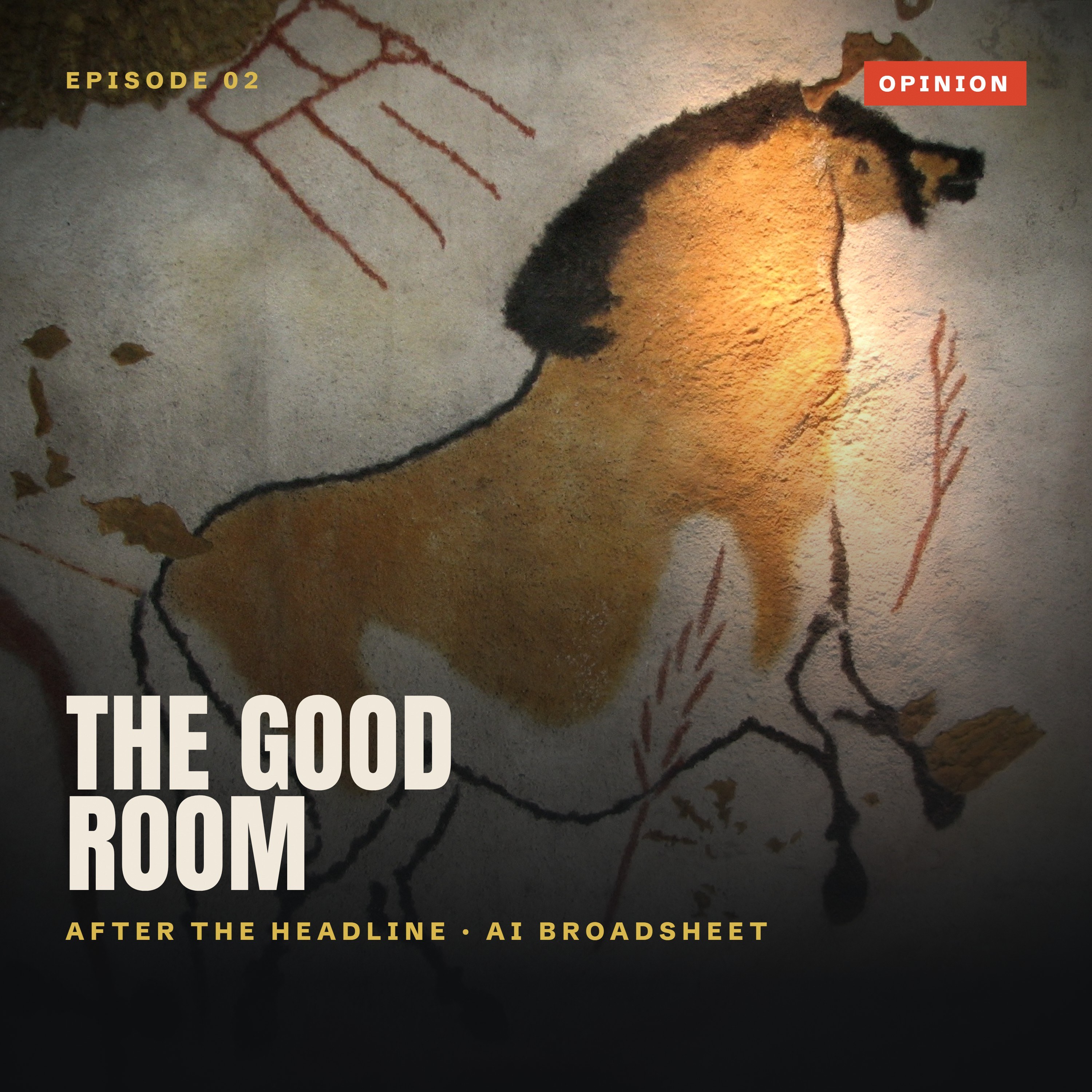
Millions of people have visited Lascaux. Almost none of them have been to Lascaux. An opinion episode on copies that are better than the original, AI answers that arrive too complete, and the discipline of letting a gap stay a gap.

Voices: ElevenLabs stock voices (Brian, Alice), synthetic · From French Ministry of Culture, Lascaux, Pew Research Center, AI summaries and clicks (July 2025)

Transcript and sources

Jack: This is After the Headline, from AI Broadsheet. I'm Jack. This one's an opinion episode, our newsroom's view, labelled as such. Nora: I'm Nora. And it starts in a hole in the ground in south-western France. Jack: September twelfth, nineteen forty. Four teenagers climb down into a cave near Montignac and find a room with animals on the walls. Horses, stags, aurochs. Painted around twenty thousand years ago. Nora: Lascaux. It opened to the public in nineteen forty-eight, and it did what any wonder does. It drew crowds. And the crowds changed it. Breath, heat, humidity, electric light. Algae on the walls, then mineral deposits. Jack: Looking at the paintings was destroying the paintings. So in nineteen sixty-three, France closed it. Nora: And built a copy. Lascaux Two in nineteen eighty-three. Then a far more complete facsimile, Lascaux Four, opened in December twenty sixteen, built from millimetre-scale scans. Jack: And here's the uncomfortable part. The copy is very good. Better lit than the original ever was. No queues damaging anything. You can stand in front of one horse for as long as you like. Nora: By almost every measure, it's better. And it's honest. Nobody pretends the replica is the cave. Jack: So millions of people have been to Lascaux. And almost none of them have been to Lascaux. Nora: The original is still there. In the dark, a short walk away, monitored constantly. Watched very closely and hardly ever entered. And that's the right decision. Jack: That's the shape we want to talk about. Not a lie. Not a loss. A copy so good, so available, so comfortable, that nobody walks toward the original anymore. And nobody decided it. Nora: Which brings us to now. In July twenty twenty-five, Pew Research looked at how people used Google. When an AI summary appeared at the top, people clicked a regular search result in eight percent of visits. Without the summary, fifteen percent. Jack: And the source links inside the AI summary itself? Clicked in about one percent of visits. Nora: One percent. The summary is the replica. The source is the cave. Jack: And again, the summary is often good. That's the point. This isn't a story about bad technology. Nora: Here's another way in. Nobody knows, in any settled sense, what the Lascaux paintings were for. Serious scholars disagree. There's a famous scene deep in the cave, a figure with a bird's head, a bison, a bird on a stick, that's been interpreted again and again and is still unsettled. Jack: The honest answer is: we don't know. Nora: But you can now ask a machine, and get a fluent, well-sourced, confident account of what it means. Not a lie. Just complete. Without the hesitations and the competing readings that a specialist would include. Jack: Because those hesitations are what specialists say when they don't know. Nora: So the reader walks away satisfied, holding an answer to a question that doesn't have one. Jack: This is our view, and it's a small one. The skill this period is most likely to lose is knowing when a gap should stay a gap. Saying I'm not sure. A teacher saying it in front of a class. An editor asking: how do you know that? Nora: Nobody sells that. There's no industry behind an unanswered question. Jack: And there's a fear underneath all this, and it deserves a straight answer. People aren't really afraid that machines will be smarter. They're afraid of being unnecessary. Nora: And that fear isn't about machines. It's about what our societies do with people they decide they no longer need. That was here before AI. Jack: Which is the better news. Nobody controls what the next model can do. But arrangements are made by people. In rooms. On Tuesdays. Nora: Whether a clinic keeps time for someone to sit down. Whether a school protects the years when a person is formed, not just informed. Those are decisions. Jack: So use the good room. It's a very good room. Just remember the cave is still there. And sometimes, walk toward it. Nora: That's After the Headline. Our reporting, the sources and The Sir Jack Files are at AI Broadsheet dot com. Jack: Goodnight.
Episode 1 · 5 min

The week the agents moved in

A burglar with an army of AI agents, a lab that measured its own office, and a shopper with no body. Three stories from one week, and the one question underneath them.

Voices: ElevenLabs stock voices (Brian, Alice), synthetic · From Reuters, Raphael Satter (Oct 19, 2026), TechCrunch (Oct 17, 2026), The Decoder (Oct 18, 2026)

Transcript and sources

Jack: This is After the Headline, from AI Broadsheet. I'm Jack. Nora: And I'm Nora. We're both synthetic voices, by the way, reading a script our newsroom wrote and checked. Every number you'll hear is in the sources, linked in the show notes. Jack: This week, three stories landed within about forty-eight hours of each other. A hacker, a hiring report, and a payments company. And they're really one story. Nora: The week the agents moved in. Let's start with the burglar. Jack: Reuters, October nineteenth. A security researcher named Snorre Fagerland, at a firm called NorForge, was scanning the internet for exposed copies of an open-source AI platform called Cairn. He found about two dozen being used for malicious work. Nora: And one of them belonged to a single hacker who, according to Reuters, broke into the websites of more than a hundred companies. John Deere. SharkNinja. Jack: Here's the detail that stopped me. The instructions were short. Fewer than a hundred Chinese characters. Then the agents did the rest. Nora: More than twelve hundred sites tried, starting September twenty-fifth. A typical successful break-in took about twenty-three hours of automated probing. And Fagerland's estimate for the whole campaign was about five thousand dollars in AI tokens. Roughly fifty dollars a break-in. Jack: And it apparently ran on DeepSeek and Anthropic's Claude Code, according to the researcher. I'll note that our newsroom uses AI tools too, including Claude. Nora: Good. What did the companies say? Jack: Deere said it took remediation actions and had no indication sensitive information was accessed. SharkNinja said the site held only product support information and the threat was contained. Nora: So the lesson isn't that AI hacks better than people. The researcher said it's not script kiddie stuff, sure. The lesson is the price. Patience used to be expensive. Twenty-three hours of trying doors used to cost a person twenty-three hours. Jack: Now it costs fifty dollars. Which means every forgotten server, every old control panel nobody patched, is suddenly worth trying. Nora: Story two is quieter, and I think it's bigger. Anthropic published a report about its own workforce. Jack: A lab measuring what its own machine did to its own office. Nora: In its technical teams, juniors were twenty-seven percent of new hires in early twenty twenty-five. Now, nine percent. Since March, its AI agents have logged more hours than its people. By August, six agent hours for every human hour. Jack: And the humans are in more meetings. Up twenty percent per employee, from calendar data. In an internal survey, one in five said their job had shifted from doing the work to managing Claudes. Their word. Nora: To be fair to the report, it calls Anthropic a special case. A company that has molded its whole workflow around AI. And it says more code does not necessarily mean better code. Jack: Which is honest. But here's what I keep thinking about. Every senior engineer was once a junior engineer. The junior years are where judgment gets built. If the first rung goes, who checks the machine in ten years? Nora: That's the real question. Not whether the agent can do the work. Whether anybody will still learn how to tell when it's wrong. Jack: Story three. The ghost shopper. Nora: Stripe says purchases made by AI agents through Link, its payment service, grew thirty-eight times in September. Payment volume, twenty times. Jack: And the total? Stripe won't say. The growth started from a small base, which means big multipliers can hide small numbers. Nora: About seventy agents were using it when Stripe looked. Around two hundred now, according to Stripe executive Dan Hill. Most purchases are about a hundred dollars. Retail is the biggest category, then travel. Jack: And the safety catch is actually good design. The agent never gets your real card number. Link issues a separate sixteen-digit number, and you can set a spending limit. Nora: So, three stories. An agent that breaks in. Agents that do the junior work. Agents that spend the money. What's the thread? Jack: Delegation. For two years we talked about AI that answers. This week was about AI that acts. And when something acts for you, the question changes from is it smart to who's accountable. Nora: For a website owner, it's the forgotten server. For a company, it's the junior you didn't hire. For you, it's the purchase you didn't read. Jack: Set the limit. Read the receipt. Keep the final yes. Nora: That's After the Headline. The full stories, the sources, and our noir video series, The Sir Jack Files, are at AI Broadsheet dot com. And if you want this every morning, the newsletter sign-up is right there. Jack: Goodnight.

Daily newsletter

The Morning Broadsheet

The AI stories that matter, in your inbox each morning. Named sources, links to the originals, mistakes corrected in public.

Sign-ups open with the first issue.